George Ridd, plot PP25
18th of August 1872 - 30th of August 1941
George Ridd was the son of James and Hannah Ridd and was born at Church House, Georgenympton, near South Molton, North Devon. The village was formerly Nymet St George or George Nympton.. His Mother, Father, Grandfather, and Great Grandmother (b.1762) are buried in Georgenympton Churchyard, along with many other Ridd relatives in unmarked graves.
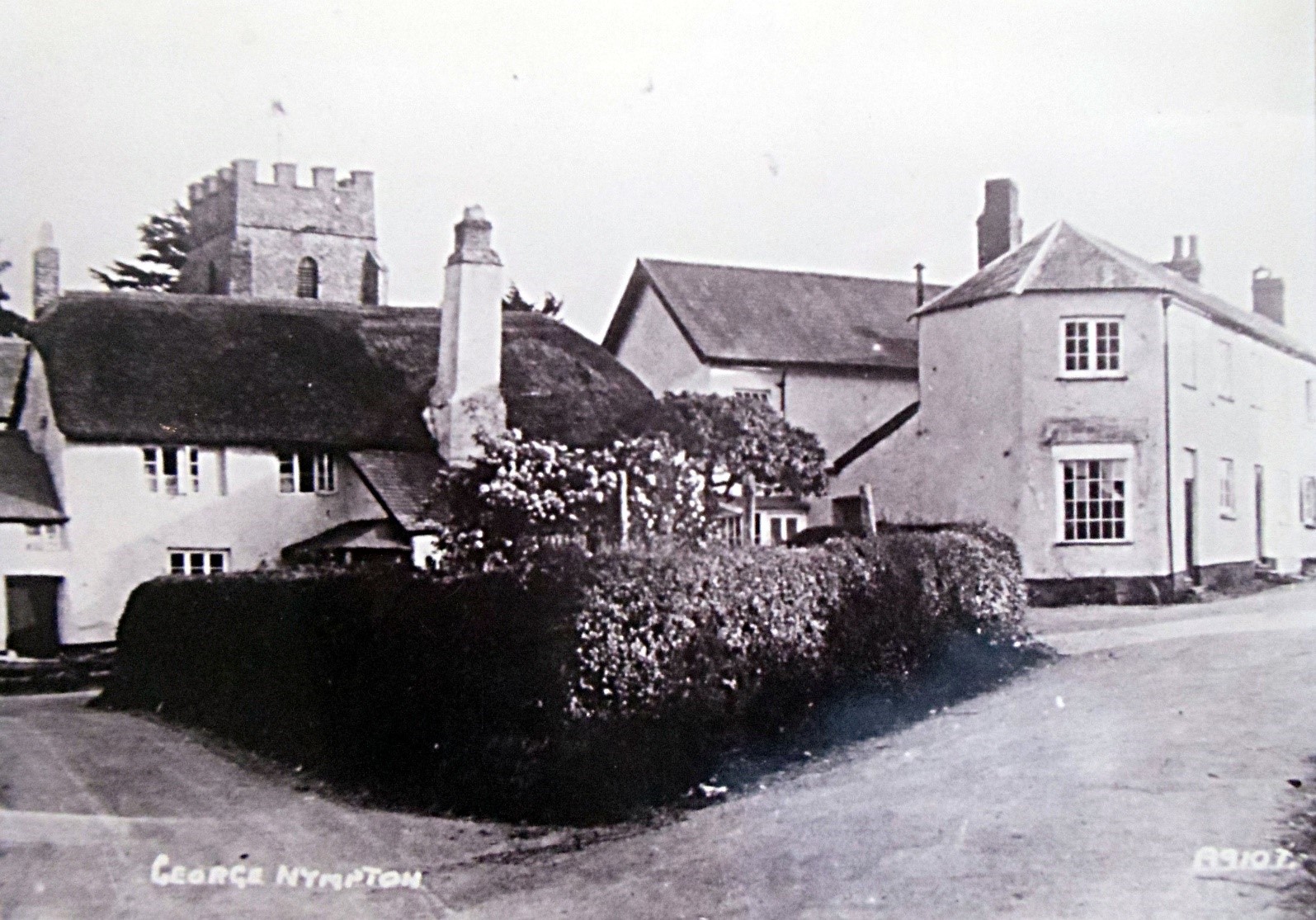 Church House is the thatched building on the left
Ridd is an old Devonian name, probably derived from Red, that is, someone with red hair or a red complexion. The surname was popularised by R.D. Blackmore in 1869 when he wrote “Lorna Doone” and chose the name of John Ridd for his hero. The book has never been out of print since then.
Blackmore visited several North Devon families with his Father, a Curate near Barnstaple, and his Grandfather, a parson in Oare and Combe Martin. Ridd's lived in several villages in their parishes, and he came to know them well. There is no question that he found his gentle giant Jan Ridd amongst them.
George Ridd was born three years after the book was published. It was still very popular and the family knew it. George’s youngest brother, Albert, named his daughter Lorna as a result, and George became known as Jan.
George attended the village school across the green from Church House, and thanks to the new Education Act of 1870, he received a good basic education in the 3Rs. His father, James, was a wheelwright in the premises across the road from the school and probably taught George some woodworking skills.
There was less and less employment for young men in the villages anymore as Britain’s economy boomed during the Industrial Revolution and days of the Empire. Thousands of young people from the countryside relocated to the towns, a movement known as the Rural Exodus. George and his older brother Charles, a tailor, moved into Exeter together and shared lodgings at 8 St Anne’s Road, Heavitree. Their brother Frederick married an Exeter girl and later emigrated to the United States, while the youngest brother Albert stayed in Georgenympton and took over his Father’s trade as a wheelwright.
 8, St Anne’s Road, Exeter
By 1901, aged 29, George was living in Heavitree, where the banns were called for his marriage to Mary Alice Maud Stanbury, known as Minnie, a Teignmouth girl. Their son, George Stanbury Ridd, was born in 1905. By 1911 they were still in Exeter, with George working as a joiner and living at 10 Danes Road. In an attempt to preserve a link with the book, George named the house “Lorna Doone”, but the Census Enumerator misheard and recorded it as “Norman Doone”! George was also recorded as from George Wympton.
 “Lorna Doone”, 10 Dane’s Road, Exeter
By 1914 the family had moved to Teignmouth, presumably to be nearer to Minnie’s family. They perhaps wanted to be there during the war years, and share any anxieties with the family. George had also lost his brother Charles to sudden pneumonia that year, and perhaps felt like starting again. He was too old to be called up. Whatever the reason, he changed trade and opened a tobacconist’s shop at 15 Fore Street, taking over from the Steers, also tobacconists. They lived above the shop. There they remained for the next 17 years, where young George Stanbury Ridd became a bank official. They retired in 1931, George aged 59, and Minnie aged 51. They passed the property on to S.J. and Vera Markham, who ran the shop until it was demolished in the 1970s for a new road-building scheme. The Markhams endured the Second World War there. Their daughter Pat Markham, later Pat Prince, recorded her memories of the sweet and tobacco shop during an air raid for the BBC’s People’s War Project.
 George Ridd outside his tobacconist’s shop at 15 Fore Street, Teignmouth
George and Minnie moved to 37 Bitton Street, then at the top end of Fore Street. At some stage in his life George and his brother Charles became members of the National Deposit Friendly Society, formed in 1868 to support the health and welfare of families. There was no NHS, so the NDFS provided health insurance, pensions, savings and investments. The company still exists in Bristol 152 years later.
On 16 April 1932 the North Devon Journal carried an article about the Devon Division of the NDFS’s AGM at Barnstaple and George was listed as a representative. He is noted as having represented the Devon Division at the Annual Conference and also offering to host the 1931 AGM at Teignmouth. George kept his links with his family in north Devon and would probably have visited them on this occasion.
In 1932 he attended the funeral of Mary Shapland of north Devon, an old family friend and possibly a cousin, attending with his brother Albert. The two families were firm friends when they had all lived in Georgenympton, and George did not forget his family roots.
On 4 December 1937 Minnie died, aged 58, leaving George alone at 37 Bitton Street, but then he moved in with his brother-in-law, Thomas H.L. Stanbury, also a widower, who was a retired tailor. He had by then become a District Secretary of the National Deposit Friendly Society, one of the most prestigious positions within the organization. It was the dedicated work of the District Secretaries that made the NDFS the success that it was.
Thomas Stanbury lived at Hazledown House on the Exeter Road in Teignmouth, now gone. It was here that George died on 31 August 1941. He had sought comfort with the Stanbury family during WW2 and did not die alone.
Probate was granted to George Stanbury Ridd and his solicitor, on 15 October 1941. George’s effects were £4993 15s 3d. This would appear to be a substantial sum by today’s reckoning, so possibly George had savings with the NDFS.
The headstone at PP25 in Teignmouth Cemetery reads:
In Loving Memory of
Mary Maud Alice (Minnie)
Wife of George Ridd
Died 4 Dec 1937
Aged 58
Also of
George Ridd
Died 30 August 1941
Aged 69
“May Thy Will Be Done”
 George and Minnie Ridd’s grave during a clean-up in June 2020
From the few records that George left behind, pieces of his character emerge. He was adventurous, moving from the tiny village of Georgenympton to a growing Exeter in order to take a job as a joiner. He was proud of his roots and proud of his Devon heritage, especially the connection with the book Lorna Doone. He was sufficiently romantic to identify with it and maintain the family connection. He was a flexible worker and multi-skilled. He had three careers, that of a joiner, retailer of tobacco goods, and District Secretary of the National Deposit Friendly Society. His underlying beliefs were those of deep care and concern for its members and he worked tirelessly towards furthering its cause of providing medical care, pensions, insurances, etc. Had he lived another few years he would have been an enthusiastic supporter of the setting up of the NHS. George was a people person, someone who could chat to customers in his shop and also care for their welfare. He loved Minnie enough to move to Teignmouth to be near to her family, and he forged a close bond with them so that it was them he was with when he died.
Jenny Ridd
16 June 2020


