An extract from 'History of Teignmouth' by G.D. and E.G.C. Griffiths, Brunswick Press Limited, Teignmouth, 1973
The Black Years
In the year 1272, Edward the First came to the throne of England. By then, the little fishing village of Teignmouth was beginning to make a name for itself as a port.
The following is an extract from the Originalia Rolls of 30, Edward the First, 1302.
"The King to his trusty and well-beloved Thomas de Verblyngton, and Peter de Donewich, Greeting. Whereas the Commonalities have agreed that the towns of Seaford, Shoreham, Portsmouth, Southampton, Lymington, Ermme, Poole, Wareham, Lyme, Teignmouth, Plymouth, Fowey, and Bridgwater, shall in response to Our request send a certain number of ships well armed to Us in aid of Our War against Scotland, namely, from the aforesaid town of Southampton two ships, and from each of the other towns aforesaid one ship, and the said Commonalities, however, have not taken care to send the said ships, as they promised, from which we hoped to have assistance in Our expedition of war aforesaid, in contempt of Us and the manifest hindrance of Our aforesaid Expedition of war.
Being unwilling therefore to leave so great a contempt unpunished, We have appointed you all those Commonalities and Towns aforesaid who did not come to Us, or who promised to send Us ships or men in aid of Our aforesaid war, and did not come to Us in accordance with their promise, or did not send ships or men as aforesaid, in such a manner as your discernment shall see fit to do, etc etc."
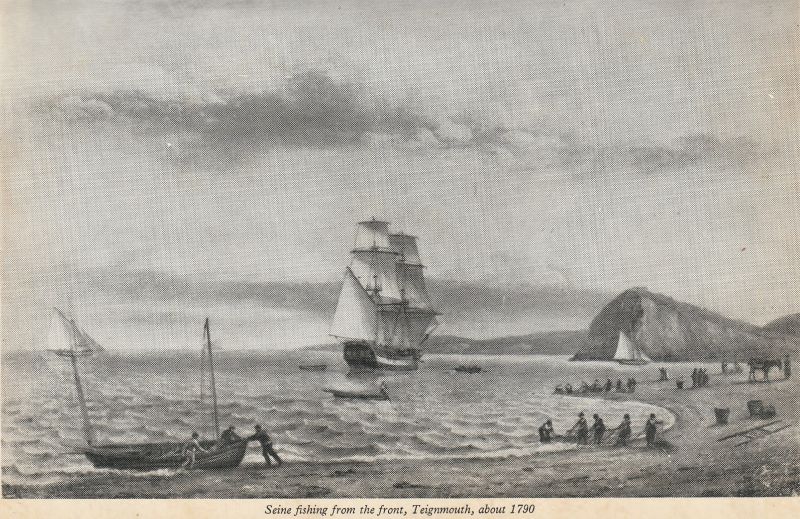
Later in the same year, Peter de Dronewich was appointed to act with the Sheriffs to induce the Bailiffs and goodmen of various ports to send ships furnished with men and arms against Scotland.
Teignmouth and Dawlish sent one ship between them.
Edward the Second asked several towns, including Teignmouth. to send a ship and men for the war against Robert de Brus (Robert Bruce). He offered to pay the men wages while they were in his service. Later, the whole order was cancelled.
In 1317, we find Robert de Horton in trouble about a shipload of provisions that had gone astray. The ship was La Redecoge, of Teignmouth, which had been blown off its course by contrary winds and had finally landed in Ireland. The cargo consisted of 1,016 hake, valued £5.2.0d, congers, valued £3.4.0d, and some oats and salt.
Arnold Wikeman, a merchant of Teignmouth, undoubtedly appears to have been a smuggler. His ship, the Michael, of Teignmouth, was arrested at Dartmouth by Galfrid de Say, Admiral of the Fleet.
The growth of the town as a port was largely due to the Bishops, who interested themselves in the prosperity of Teignmouth, from which they received tithes, one-tenth of annual produce or earnings, formerly taken as a tax for the support of the Church and clergy.


