
Admiral James Anderson, by Jenny Ridd
Born in 1797, James Anderson served in the Royal Navy from 1808 to 1849 and rose through the ranks to become Rear, then Vice, then full Admiral for the last two years of his life, until his death in 1882. He finished active service as a Commander and received a pension on retirement.
After Nelson’s decisive victory at Trafalgar in 1805 and the protracted struggle with Napoleon finally ending at Waterloo in 1815, the Navy was forced to adopt a new role. The age of continual battle was over, Nelson was dead, and the Navy had to embrace the business of peace, not war. The legacy of the mighty Georgian navy had been its crucial part in the nation’s safety and the defeat of France. It had gained Britain undisputed supremacy of the seas for the next 100 years and had firmly established the nation as a leading global power.
James Anderson, a mere boy when he joined up, enlisted in the Georgian Navy, but ended up in the Victorian Navy as his career progressed. By the time Victoria came to the throne in 1837, James had witnessed an expansion of free trade, the extension of the colonies and the inception of Victoria’s peacetime navy, a fleet which protected Britain’s economic interests abroad, as well as being involved in exploration, surveying and the suppression of the slave trade.
There was no longer a need for the great “wooden walls” of the old frigates, or the vast numbers of seamen to crew them. In the end, it was the coming of steam that served the death knell. The change from sailing to steamships was a gradual process, in part because the old admirals fought an invention they did not understand or want to know about. The Navy finally succumbed to a combination of sail and steam, the best example being HMS Warrior at Portsmouth, launched in 1860, part wood, and part iron. Another of Teignmouth Cemetery’s residents, Admiral Rombulow Pearse, was an example of how much things had progressed by the second half of the 19th century.
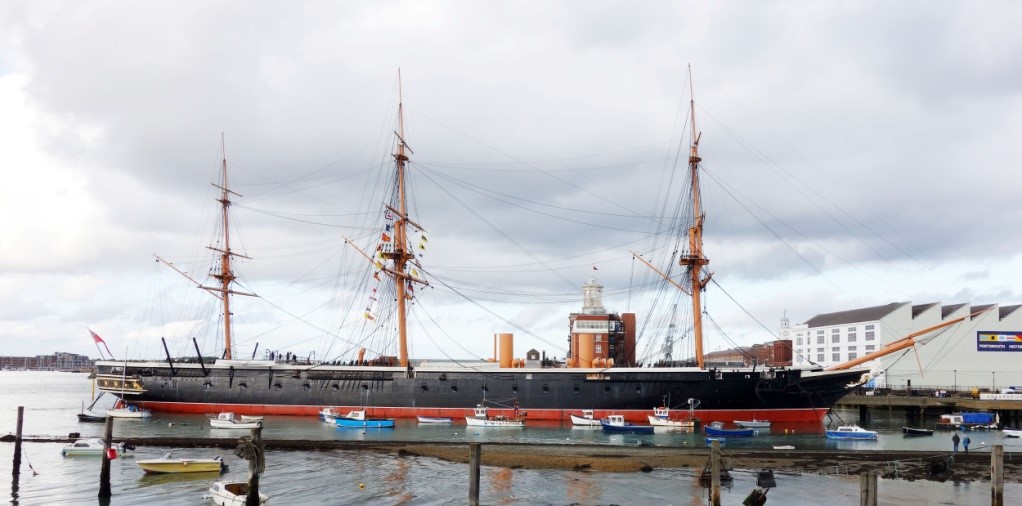 HMS Warrior conserved at Portsmouth
 Teignmouth print showing the variety of small ships and even a steamship (extreme left)
Much of the business of the Victorian Navy fell to the smaller ships like brigs, sloops and packets. A brig was a two-mast square-rigged ship used for short coastal trips; a sloop had one mast, and parallel the cutter, a convoy vessel used for auxiliary naval duties; a packet-boat sailed regularly between two ports carrying mail, goods and sometimes passengers, but eventually steam propulsion took over.
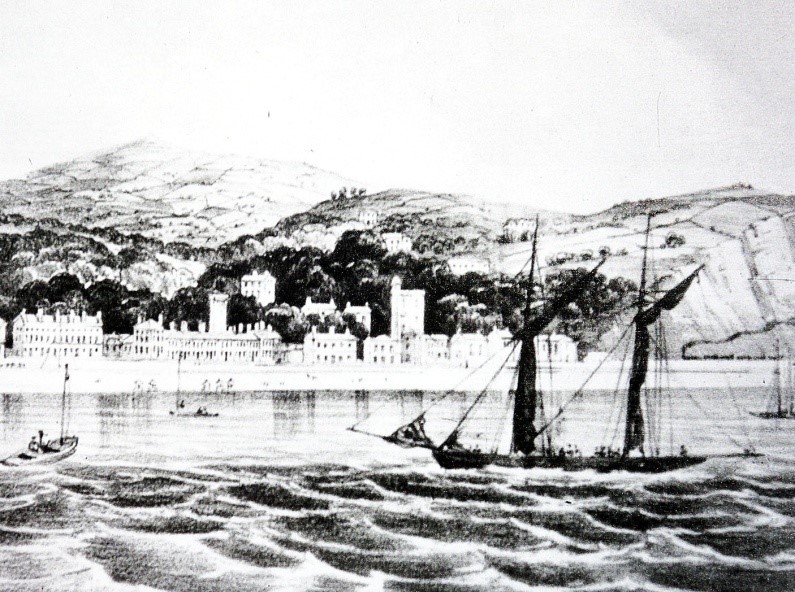 A two-mast vessel off the Den Teignmouth
It was this world then, with which James Anderson became increasingly familiar as his career progressed. During his service, he was on board 20 different ships, eight of which were large warships or flagships carrying 98, 84, 80 or 74 guns, but the rest came into the above-mentioned category. It must have been difficult for him to adapt from serving in a large vessel with many guns to a smaller sloop with only 10 guns, but it would have given him excellent all-round, hands-on experience as to the nature, purpose and tactics of ships of every size used by the Navy. He would have understood everything from the complex set of sails on a 98 gunship to the running of a single-mast 10 gun sloop – no mean feat. James became a highly-experienced, flexible, all-rounder and consequently of valuable service to the Navy, which, despite its general peace-keeping activities, did engage in a war with the USA in 1812 using its warships, but created a lot of “nuisance-value” with its smaller vessels.
There are scant details about James’ early life. He was born in Hackney, London, in 1797 to James Anderson, the Senior Clerk in the Post Office and Rosetta West, James Snr’s first wife. He was baptised on 23 July 1797 at St John-at-Hackney, but his mother’s name does not appear on the baptismal certificate, so there is some uncertainty.
 St. John at Hackney, London
In 1804 William George Anderson was born, a half-brother to James, suggesting that his mother had died and James Snr had remarried. In 1807 another half-brother, Charles Henry, was born in Chingford, Essex, on 17 May. William George became Assistant-Paymaster-General and is mentioned in the Paymaster General Act of 1848 as an Accountant. He was later made a KCB. Charles Henry became a cashier in the General Register Office, so they remained London-based. It was their step-brother James who became the adventurer.
How or why James came to join the Navy is not known. Possibly as the new family unit bonded, his stepmother preferred not to raise him. Whatever the reason, James entered the Navy on 17 September 1808 at the tender age of 11, one year after Charles’ birth, as an Ordinary Seaman, the lowest rank. He was expected to “learn the ropes” and came under the command and discipline of the officers while carrying out duties that ensured the efficient running of the ship.
James’ first ship was the Royal William, a flagship where he served at Spithead. He was soon moved to the Myrtle, a ship that was involved in the capture of two slave vessels off the coast of Africa. Slavery was not abolished until 1834 and so this young lad of only 13 was introduced early to the practice of human trafficking, saw action on his first voyage, and had already travelled thousands of miles.
Following the events in Africa, the young James was transferred to HMS Barfleur, a ship of the line carrying 90 guns. Barfleur was captained by Thomas Masterman Hardy, a man best remembered as Nelson’s Flag Captain, his close compatriot and his compassionate comforter in the final minutes of his life on 21 October 1805.
 Death of Nelson supported by Hardy
Young James would have been in awe at serving under this great man, for every sailor in the Navy knew the heroic tale of Nelson’s success at Trafalgar and his subsequent death onboard Victory from a sniper’s bullet. Thomas Hardy later became First Naval Lord. James Anderson would have later recounted with pride how he had served with this heroic figure.
During his first few deployments, James took an active part in the chief operations of the American War of 1812. He was transferred to HMS Ramilles, a 74 gun third rate ship of the line, whose Admiral was Thomas Hardy – now promoted. Hardy led the fleet that transported the army which captured much of the coast of Maine (then Massachusetts). Britain had disrupted America’s trade through the stranglehold caused by the sea blockade of the Continent and was causing annoying incidences with its smaller ships. Although James was serving on a large ship this time, he would have been aware of the tactics being employed. It ended with a draw at the Treaty of Ghent in 1815, with both sides claiming victory.
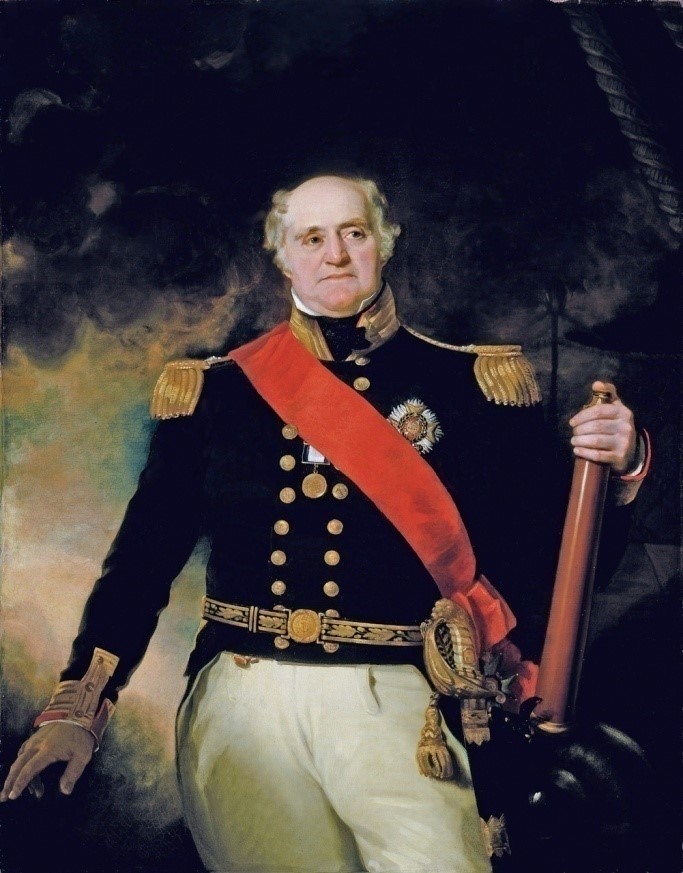 Admiral Thomas Hardy
In 1823 James was made a Lieutenant and thanks to one existing naval document we can glimpse the level of responsibility that this brought, and the maturity with which 26-year-old James carried out his work.
On January 11, presumably from his family home at 35 Hans Place, Chelsea, he wrote a testimonial for Commander Debenham, with whom he had served at Corunna at some point.
“These are to certify that John Debenham Esq, commander in the Royal Navy, served under my command on various dangerous and difficult services, with great credit to himself and to my entire satisfaction and I can recommend him with the utmost confidence, from the knowledge I have of his vigilance, diligence, attention, uncommon ????????, and great humanity of disposition, mixed with firmness, as a fit person to fill any situation particularly requiring the rare concurrence of the qualifications of Anderson”
We learn that James is educated, and perfectly able to write well and that he was fully supportive of one of his former officers. Why the reference was needed is not known, but it seems that Debenham made Commander before James himself did. It also refers to Corunna, not mentioned in James’ naval biography as being somewhere he ever went, let alone saw action. The Battle of Corunna was in 1809, but this is too early for James to have held office. However, the British still patrolled this area in Spain, keeping an eye on French activity in the region.
In that year James shipped off to Brazil and South America. In November he became Lieutenant for two years on the Britomart, a brig sloop, commanded by Edward Russell, and was off the coast of Ireland. This was during the early stages of the rise of Irish nationalist movements and the Navy’s role was to protect internal security, transport troops, blockade the coast and guard the rivers against localised threat and uprising. Once again the smaller ships that James was so familiar with were ideal to carry out this task, and as Lieutenant he would have had more responsibility for the men under him as they entered the trouble spots.
That came to an end in 1833, when James was moved to the Coast Guard. Records are not forthcoming as whether this was a ship or shore duty, or even where he served, but in either case, his role would have been one of the preventions of smuggling, which was still rife around Britain, but had changed in nature from the somewhat glamorised activities of Rudyard Kipling’s famous poem “Brandy for the Parson, Baccy for the Clerk”. It was organised, dangerous and costly to the Government, and still needed monitoring. The Coast Guard was set up in 1822 and inherited several shore stations, watch houses and coastal vessels from its predecessor, the Preventive Water Guard. As well as smuggling prevention and revenue protection, the Coast Guard was responsible for saving lives at sea where the shipwreck was involved, and in 1829 was given new lifesaving equipment, which James had to learn to use.
At this time, another invention was adopted by the Navy which James, and all British seamen, had to familiarise themselves with. The Beaufort Wind Scale was an invention by Admiral Sir Francis Beaufort in 1829 and changed the life of every sailor from then on. This was the age of great interest in science, innovation and exploration and came at a time when navigation accuracy depended on precise forecasting of the weather. The Navy needed to be able to move swiftly and accurately around the world’s oceans to safeguard Britain’s territories and trade routes against the challenge from her rivals, France, Spain, Portugal, Belgium and the Netherlands. Anderson would have used Beaufort’s Scale every day of his naval life, and of course, it is still used today as a fairly accurate way of forecasting the wind conditions before putting to sea, although technology has mostly taken over.
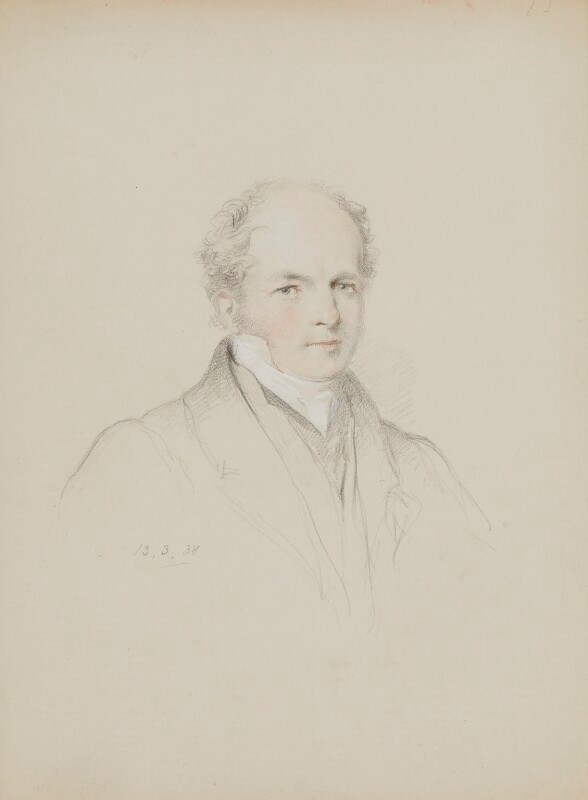 Admiral Sir Francis Beaufort
Teignmouth’s Admiral Thomas Spratt was a surveyor in the Navy (see Teignmouth Tales from the Grave), and during his career, he wrote to Beaufort, the Navy’s greatest hydrographer of all. James Anderson was a contemporary of these two giants, and could not have failed to be impressed. He would have known Spratt from Teignmouth and had been working with Beuafort’s inventions. Later, when he moved to Teignmouth, James renamed his house, Beaufort Lodge. Was this coincidence, or a deliberate act based on the impression Beaufort’s work made on him? More of that later . . .
During the 1830s James continued to be moved from ship to ship and travelled world-wide, but saw no action according to the very limited records which exist. And by the 1840s his career was winding down.
The Times newspaper, in a series of snippets, reported the movement of the Ranger from 1844 to 1848, which James commanded. By then he had attained the rank of Commander. Ranger was a packet brig of 363 tons, with eight guns, which sailed from Plymouth to the west coast of Africa “taking mails for Madeira and the Cape Verde Islands”. In one Times’ extract, James and his officers are praised for their handling of the ship, since it appears that during his three-year command he “had no sickness, and had lost only one man by desertion, and has not administered one lash to the crew, nor blacklisted a man during the whole time – facts eminently to the credit of the commander and officers, the First Lieutenant especially.”
In those few lines, we get an insight into some of the punishments still available to an officer when needing to discipline disobedient crew and this is the only personal reference to James’ character – a steady and fair man who ran his ship well and who had a contented and well-treated crew who caused no trouble.
Eventually, on 28 April 1848, Commander Anderson was paid off “into ordinary”. That usually meant that a ship was being mothballed, but this time Ranger was to undergo a refit. James was promoted to Captain and remained so for several years, never again seeing active service. Presumably, his duties for the Navy were shore-based, and they finished in 1860 when he was placed on the retired list, aged 63.
However, three years before retirement, James had a little surprise up his sleeve. He ended a lifetime of bachelorhood by getting married at the age of 60, giving his address as Milton Street, London. He married Laura Eliza Henderson, spinster, of St John’s Wood Road, London, in the presence of her father, David Henderson, Gent, and Will Henderson, perhaps a brother, and James Anderson Snr, by now an elderly man of 80 plus. The marriage took place on 2 April 1857 at Christ Church, Cosway Road, St Marylebone. This fashionable, white, pillared church was a Commissioner’s Church, that is, one built between the 1820s and 1850s to cope with the ever-increasing expansion of the population in the suburbs.
 James Anderson's and Laura Eliza Henderson's signatures on their marriage certificate
 Christ Church, Cosway Road, Marylebone, London
Laura was 11 years younger than James, and there are no clues as to why this late marriage happened, or how long they had known each other. Neither had been married before, so perhaps it was a marriage of convenience as they approached later life. By 1861 they had moved to Newton St Cyres, a village near Crediton, Devon, and it was there that Laura Alice was born in 1862. Sadly, Laura Alice only lived for 13 years and died in Teignmouth on 14 March in 1875.
In 1866 James was promoted to the rank of Rear Admiral (Ret) and by 1871 they were living in Teignmouth, the Census giving their address as Beaufort Lodge, 5 Reed Vale, Teignmouth. It is always difficult to accurately trace historic buildings because house names and numbering systems change, but the following is presented as a probable explanation of which house the Andersons lived in.
5 Reed Vale was named St Mary’s when it was built in the early 1850s by Joseph Reed, a local builder. Reed died in May 1859 and five of his rental properties in Reed Vale (obviously named after him) came up for sale at auction in September, probably to pay off any debts remaining after his death. St Mary’s was one of that batch. Details still exist from that auction.
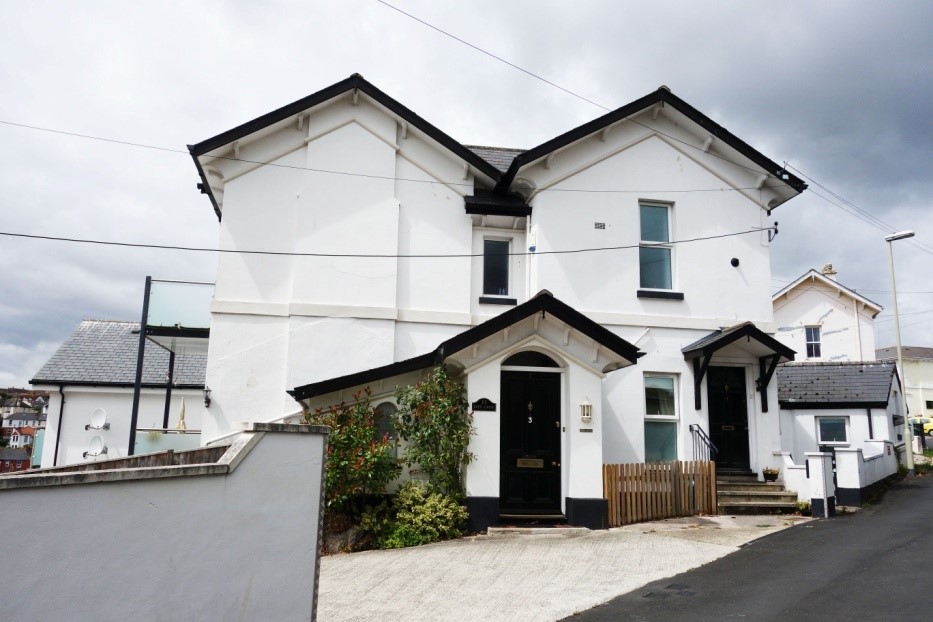 Beaufort House, 5 Reed Vale, Teignmouth
The Andersons moved there between 1866 and 1871, and James changed its name from St Mary’s to Beaufort Lodge, also confusingly recorded by as Beaumont Lodge elsewhere. However, Beaufort is the most likely, given James’ naval background. This name-changing suggests that he owned the property, as one does not usually change the name of a rented property.
The house was substantial for three people and two servants. There were four bedrooms and a dressing room, and there was even the latest Water Closet. The property had a dining room and double drawing room, a breakfast room and storeroom, and a basement which comprised the servants’ hall, butler’s pantry, kitchen, back kitchen, larder, and knife and shoe houses. The two basement bedrooms would have been used by James’ and Laura’s trusty servants, Mary Ann Skinner, cook, and Ann Middon, the housemaid. There were out-offices, a garden and a shrubbery. Interest in gardening had taken off among the late Victorians and one hopes that the Andersons’ garden was a good example. The Andersons were certainly very comfortable there.
Reed Vale was an upmarket development, a gated community with a Lodge House at the entrance, and it was on the opposite side of the road from West Cliffe House, formerly Admiral Edward Pellew’s residence. The Anderson’s property was halfway up the hill and had stunning views over the River Teign, looking down on Shaldon Bridge, by then 44 years old. The bridge was an enterprise in which Admiral John Wight had a hand, a contemporary of James’ who lived many years in Teignmouth, though is buried in Dawlish. His second wife, Anne is buried in Teignmouth Cemetery, and so his story can partly be told through her eyes.
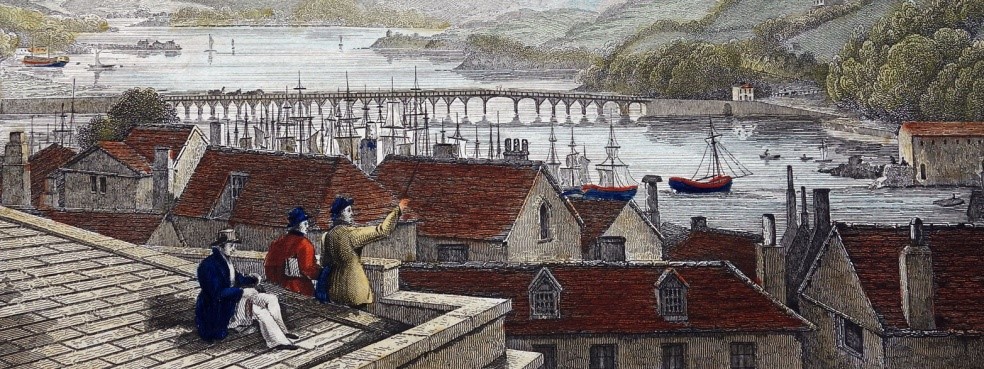 The Shaldon Bridge that James Anderson saw
Today the property still exists, although now renumbered, renamed and multi-occupancy. The Lodge House is still there, and the two concrete gateposts that bulge out on either side of the narrow road entrance still have the tell-tale remains of former gate hangings. The entrance must have been quite tight for coaches as they approached the beautiful tree-lined avenue and made their way up the hill.
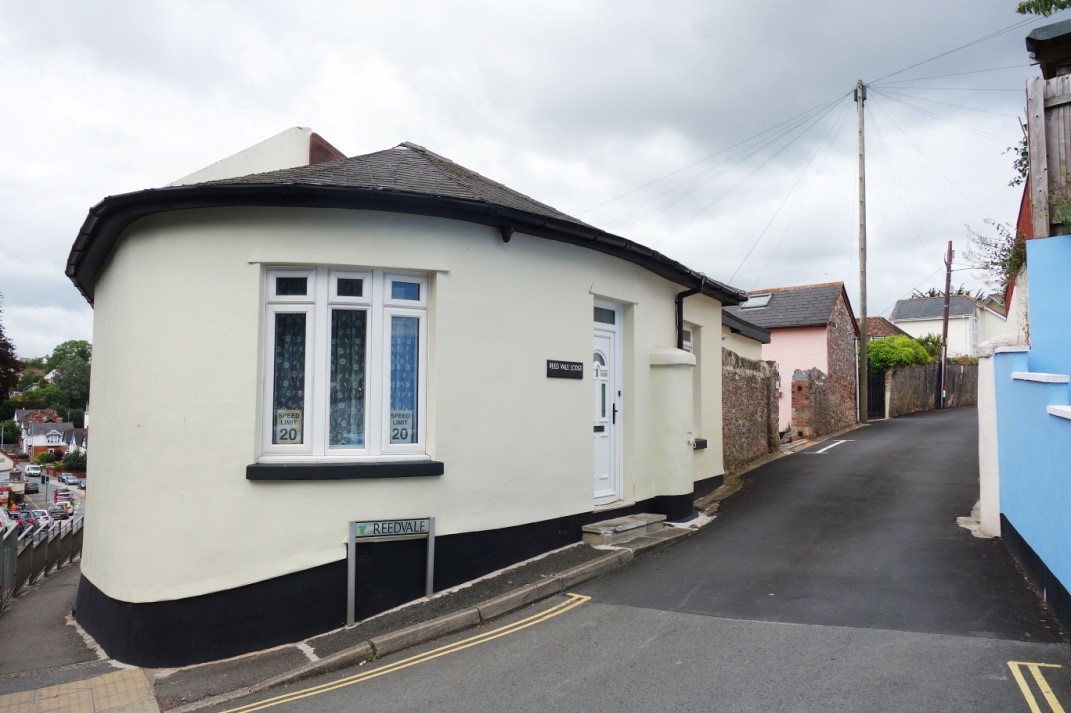 Reed Vale Lodge House, showing remaining bulges of original gateposts
Viewing the house and imagining its former context gives one an idea of the elegant nature of the lifestyle of the Andersons. In 1873 James was promoted to Vice Admiral (Ret), aged 76, was receiving a good pension, and was very well off. In 1878 he was made full Admiral at 81. With this obvious wealth, it is presumed that the family enjoyed the benefits of the fashionable society that Teignmouth had to offer, with its superb Assembly Rooms and Circulating Library, bathing facilities and several other naval officers there to socialise with.
James’ wife Laura died aged 57 on 5 March 1880, and so lived to see her husband become a full admiral, with all the attached kudos. She is buried with James and their daughter Laura in Teignmouth Cemetery in a modest railed tomb.
James’ life ended alone at Beaufort Lodge with only Mary Ann Skinner, his faithful cook, and a maid, looking after him. He died on 7 March 1882, leaving a personal fortune of £30,911 to his half-brother William George Anderson, KCB, and one other unnamed family member, perhaps his other half-brother Charles Henry. This would equate to over two million pounds today.
James Anderson’s grave can be seen in Teignmouth Cemetery at Plot L 41 East, an ordinary monument to an ordinary man who succeeded well in his chosen career. Although not a hero, he deserves to be remembered as a worthy and steady contemporary of the other Teignmouth admirals. Born a Georgian, he ended life a Victorian, having seen the move from sailing ships to steamships, and had witnessed Britain move from war to peace, and from great nation to great Empire.
This has been a collaboration using:
“Bishopsteignton - Home to Nelson’s Admirals” by Jenny Ridd. Various published articles, talks etc
Admiral Anderson’s specific personal details were researched by Geoff Wood from documents found on Find My Past and including several other naval sources
Photographs are by Peter Marsden and Geoff Wood
A further source wishing to remain anonymous was helpful on local details


