
Ann Wight - her life and marriage to Admiral John Wight, by Jenny Ridd
History has seldom been told through the voices of women, especially if those women were married to men who held prominent or adventurous jobs. Their role was to support their husband, ensure the efficient running of the household and be able to socialise effectively. But sometimes silence and omissions tell their own story.
And so it was with Ann Wight, whose story can only be told by recreating the life of her better-recorded husband, John Wight, whose career in the Royal Navy ensured documentation in naval biographies and other maritime papers about his career, although few personal details. However, even this is of little use in Ann’s case, as she was John’s second wife and he married her in 1830, 25 years after his naval career ended in 1805. That said, John and one of his children from his first marriage, George, have left a trail of patchy evidence about a life which was not quite what it seemed, and Ann was very much a victim of circumstances.
Ann was born Anne Prowse to Clement, a mariner at Shaldon, and Susannah Prowse, in 1800. George 111 was on the throne, the Napoleonic Wars were raging and Britain continued to protect her southern shores from invasion by France. As a man of the sea, perhaps Clement Prowse was peripherally involved in that protection. Ann’s mother was illiterate, only making her mark at her wedding. They were from humbler circumstances than John’s Wight’s family, whose mother was the first cousin to Admiral John Schank, a naval engineer and inventor of some note.
Ann and John were married at Ide church, just outside Exeter, on 27 February 1830, when she was 30 and he was 54 and a retired Captain of the Royal Navy.
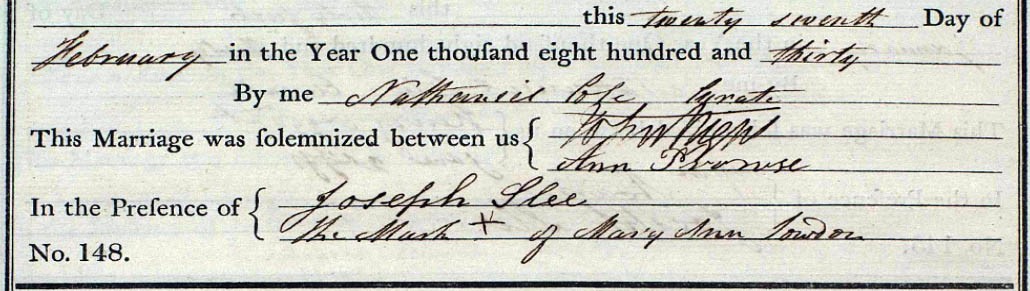
John had been a widower since 1812, and given the age difference of 24 years, this may have been a marriage of convenience. At 30 Ann would have been “left on the shelf”, and given her less comfortable beginnings, this would have been a very suitable union for her. She may have settled for being more housekeeper than a wife. How much she knew about John before she married is debatable, as her life took an unexpected turn of events not far into the marriage.
Ann had to accept and be accepted by, John’s adult children. Records are scanty or non-existent concerning John’s children with his first wife, Margaret Schank, Admiral Schank’s daughter. They seemed an ill-fated family. Their first son Algernon, born 1803, died aged twelve. He was drowned in the River Teign. John, the second son, born 1808, changed his name from Wight to Schankwight, or sometimes just Schank, in 1840. It was a requirement of his grandfather’s Will that all the children took the name and arms Schank. Margaret Elizabeth was born in 1810, she married but died young. George John was known to be the youngest, but his birth date is unknown. It probably was 1812, and his mother Margaret might have died giving birth to him. He did not ever change his name. George was the black sheep of the family and had problems within his profession. When Ann came into the family in 1830, John was 22 and a solicitor in Teignmouth, Margaret was 20 and engaged, and George was around 18. One of the sons became a Midshipman in the Navy, but which son, when, and for how long is unknown.
Ann and John had only been married for about six months themselves when daughter Margaret married Mather Byles at St. Michael’s in Teignmouth. The family dynamics may have been a little strained for Ann. Mather Byles’ father, Mather Byles, was an admiral who lived at Barton Terrace, Dawlish, a few doors down from John Wight’s first father-in-law and patron, Admiral John Schank, at Barton House. The two Johns and Mather senior were a close-knit group; they were all inventors and eventually were all admirals. Daughter Margaret was marrying into an old-established family. There were six generations of Mather Byles, the first being a clergyman in Boston, USA, in the 1700s. The last was the son of Margaret’s husband Mather, not by Margaret, but by his second wife. Ann may have found it a bit difficult to fit in.
Four years into her marriage Ann underwent one of the biggest shocks of her life. For reasons unknown, John became an insolvent debtor (i.e. a person unable to pay their debts), and had spent time in His Majesty’s Gaol at St. Thomas the Apostle just outside the city of Exeter. This was the Debtor’s Prison in what is now known as St. Thomas, Exeter. He was discharged and released in March and ordered to pay £60 annually of his pension towards liquidating his debts. The London Gazette gave notice on 1 April that a meeting of the creditors would take place at 11 am on the 16th of April at John Wight’s office in East Teignmouth. This was the office of John Wright the son, an Attorney at Law, and the meeting was “to approve and direct in what manner and at what place or places, the real estate of the said Insolvent shall be sold at public auction”.
Poor Ann. On top of having had her husband in jail, she was now to lose her house and possessions through no fault of her own. Records do not tell us where the Wights had been living. It is possible that Grace Griffith, in her original “History of Teignmouth” has provided a clue, when she mentions “Admiral Wight of Cambrian House” - except that John was not yet an admiral, but still a captain. It is possible that this beautiful cottage orné on the Dawlish Road on the hill out of Teignmouth and built by Rev Commander Laurence Gwynne before 1818, had been acquired by John when Margaret was still alive, and he had moved Ann in on their marriage.

This could have been the “real estate” alluded to in the London Gazette, but this is speculation. The deeds which might provide a clue are with the present owner’s solicitor and unavailable.
Records simply do not exist which tell us why John got into debt, or why he had to sell his house, wherever it was. The best we can do is hypothesise, based on clues about John’s interests. A likely cause of his debts was his interest in inventions, just like his first father-in-law, Admiral Schank, who had probably encouraged him. In 1824 John Wight invented a rudder “for the ease and safe conducting all classes of HM ships and those in the Merchants’ Service”. Presumably, the Navy trialled the rudder, but whether it succeeded or failed is not noted. If it failed and John had invested a lot in developing it, that would account for the debts. Perhaps he overinvested and overspent and failed to get any return.
Then in 1827 John became “Commissioner of Roads and Bridges” in Teignmouth and was one of a committee of men who oversaw the raising of funds for, and the building of, Shaldon Bridge. From the moment it was proposed John had an interest in the bridge construction and his name appears in the initial 1824 Act of Parliament for the new bridge. By 1825 he had shares in the Teignmouth and Shaldon Bridge Company, a private company with investors and a management committee, of whom John was one.

A year after completion, in 1828, Roger Hopkins, the bridge’s civil engineer, was asking to be paid an outstanding £1000 and the Company was considering approaching the Exchequer Bill Loan Company for an extension of the time on the loan from 20 to 24 years. The total cost of the bridge was £28,000.
It is quite conceivable that John invested too heavily and could not clear his debts before marrying Ann. The question remains – when did she find out that he was in debt - before or after marrying him? One can only imagine the ripples of shock which cascaded through the family, let alone how Ann coped. His Navy pension was not affected, nor his assured promotion to Admiral, but his reputation would have been somewhat dented, especially as his main champion and supporter, Admiral Schank, had died in 1823.
Whatever the cause of the debts, Ann and John were forced to move and by 1841 were living at “Mina Duble Cottage, Dawlish”. The Census Enumerator for that day in 1841 had misheard, and therefore misrecorded, the name “Minadab”, that characterful cottage orné on the Dawlish Road, built about 1820 by Commander Robert Benjamin Young, a Trafalgar veteran, and reputedly named after two ships on which he served, the Minnow and the Dab.

Living with Ann and John at Minidab was George Wight, aged 18 and born in Devon in 1823. The 1841 Census does not give family relationships, so we are left wondering who this George is. It is probably a grandson, son of John Wight Junior, but Wight family records are notoriously poor and do not tell us. Whatever their previous misfortunes, Ann and John had two servants.
The credit scenario continued, though. A notice appeared in the London Gazette on 25 July 1843 entitled “Insolvent Debtors’ Court – Dividend – No 35583C”. It said, “The Creditors of John Wight, late of Dawlish, Devonshire, Captain in the Royal Navy, are informed, that a Dividend of seven shillings in the pound may be received, by applying to Mr J.M.S.G. Schank, of East Teignmouth, Solicitor for the Assignee, on or after 31st day of July instant - Bills and securities to be produced”. The creditors would see little return on their investments. There are two things here to note. Firstly John is described as “late of Dawlish” yet he was still at Minadab, which we now consider to be Teignmouth. And the J.M.S.G. Schank who was representing him was his son John Wight. John was baptised John Mackellar Skeene Grieve Wight, but “assumed the surname and arms of Schank in place of his patronymic Wight”. In 1840 John Junior changed his name to his mother’s, as his grandfather had requested in his will. This safely disassociated him from his namesake father and the debts. In his will, Admiral Schank had left his Dawlish property (presumably Barton House) to his daughter Margaret’s children, and now, to avoid anyone selling it to pay off John Wight’s debts the property had been put in trust, which was administered by none other than Admiral Sir Edward Pellew, Lord Exmouth. Schank had been Pellew’s commanding officer on board HMS Blonde, they were friends of long association, and he knew Pellew well enough to entrust personal matters to him. According to Stephen Taylor in his book “Commander”, Schank was a tiresome old bore “who preened around the Exmouths like an unctuous vicar, but was never treated with less than indulgence”. Pellew once said to a friend that he tolerated Schank because “I love the old boy”.
In 1848 John was promoted to Vice Admiral and his pension raised a little, which may have eased things for Ann. In 1849, George John, Ann’s stepson, married Sarah Payne in Teignmouth. Ann might have been lulled into a false sense of security at this point, but in actuality, there was another heartbreak just beginning for her.
George’s story is a long complicated one and belongs more appropriately in any future write-up about his father John. Suffice to say that after marrying, George and Sarah left Britain for Calcutta, where they lived for the next 16 years. George was a solicitor, proctor, notary and legal and general agent working for Her Majesty’s Supreme Court of Judicature in Bengal. Then he set up three different companies with three different males partners, working in Benares, Agra and N. West India as a Pleader (solicitor) in the Honourable East India Company. Somewhere along the line, somehow George over-extended himself and ended up out of business and being sued in July 1856. There was a complicated trail of company names and there were businesses in London as well. The charges were “a fraudulent preference, contracting debts with fraud, and a vexatious defence to an action”.
Somehow he had racked up debts of £3,866 0s 8d and his creditors took him to court. He came home on the Winifred to face trial at Westminster, was imprisoned, and although he won the case against him and was discharged, he had lost his business and was an insolvent debtor – just like his father years before. His wife Sarah, father John and stepmother Ann must have felt it was déjà vu and went through another extremely anxious time. Sarah stayed with George and the following year in 1857, bore George a daughter, Florence Maud. Where the couple lived is unknown, but they possibly returned to the London area where George had practised law before marrying Sarah.
By 1871 Sarah and Florence were living at Percy Road, Hammersmith, with a variety of Sarah’s relatives, but of George, there is no mention. The last we hear of George is that he died in San Francisco, USA, in 1875, aged 63. Florence Maud went to India, where she died aged only 19, on 19 April 1877 from diarrhoea. Her death notice commemorates her as the granddaughter of the late Admiral John Wight rather than the daughter of George, which suggests that George had deserted them and had fled to the States to avoid his past and start a new life.
The final mystery is why he is commemorated on Ann’s memorial in Teignmouth Cemetery. He is not remembered with his wife, or his father, but with his stepmother. Was she the only one who supported him through all his troubles? Did she stand by him after the heartache he had caused? Unfortunately, we will never know what happened.
Somehow Ann and John moved forward from all the insolvency issues that had dogged them and the
by-now Vice Admiral and Ann were still living at Minidab in 1851. They saw the birth of their grandson George in 1858. However, tragically, he died an early death aged only 17.
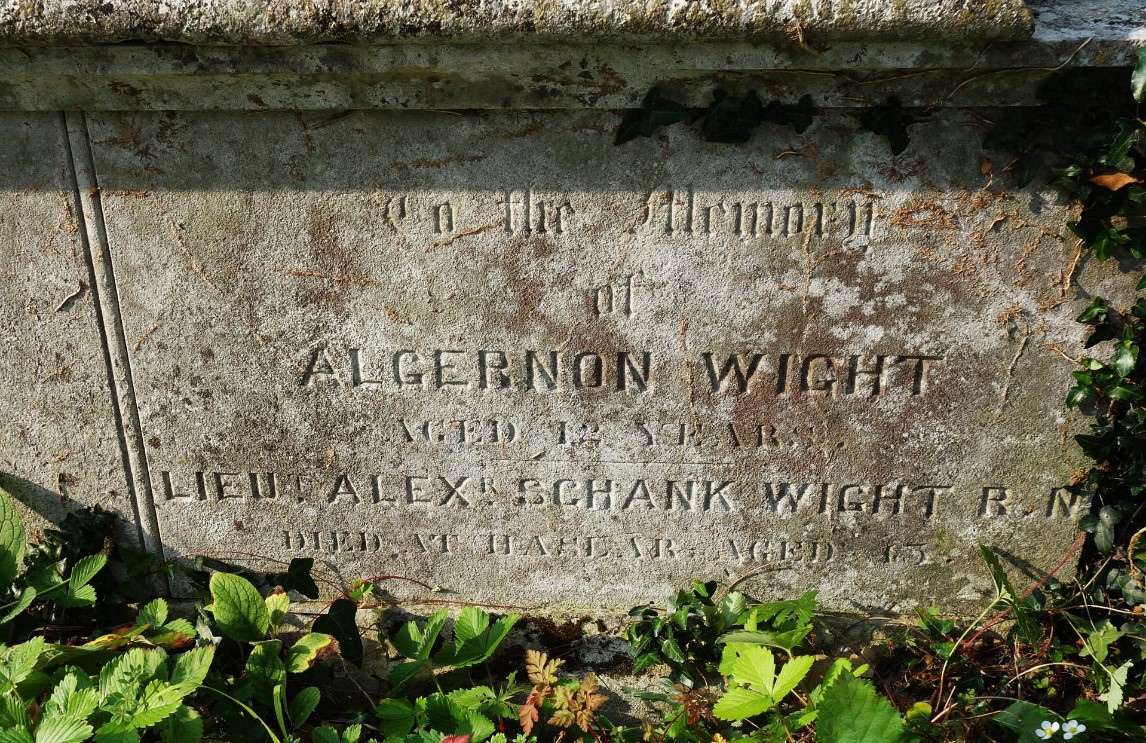
Two years later on 22 January 18, John Wight died. Despite living in Teignmouth, he was buried in St. Gregory’s churchyard, Dawlish, next to his first-cousin-once- removed, his first father in law, his patron and mentor, Admiral John Schank, in a large chest tomb befitting admiral status. Sadly, both he and Schank were long-forgotten by the time we discovered their ivy-covered graves and got permission to clear and clean them to read the inscriptions. John’s reads “To the memory of John Wight, Admiral of the fleet, Died 22 January 1860, aged 87.”
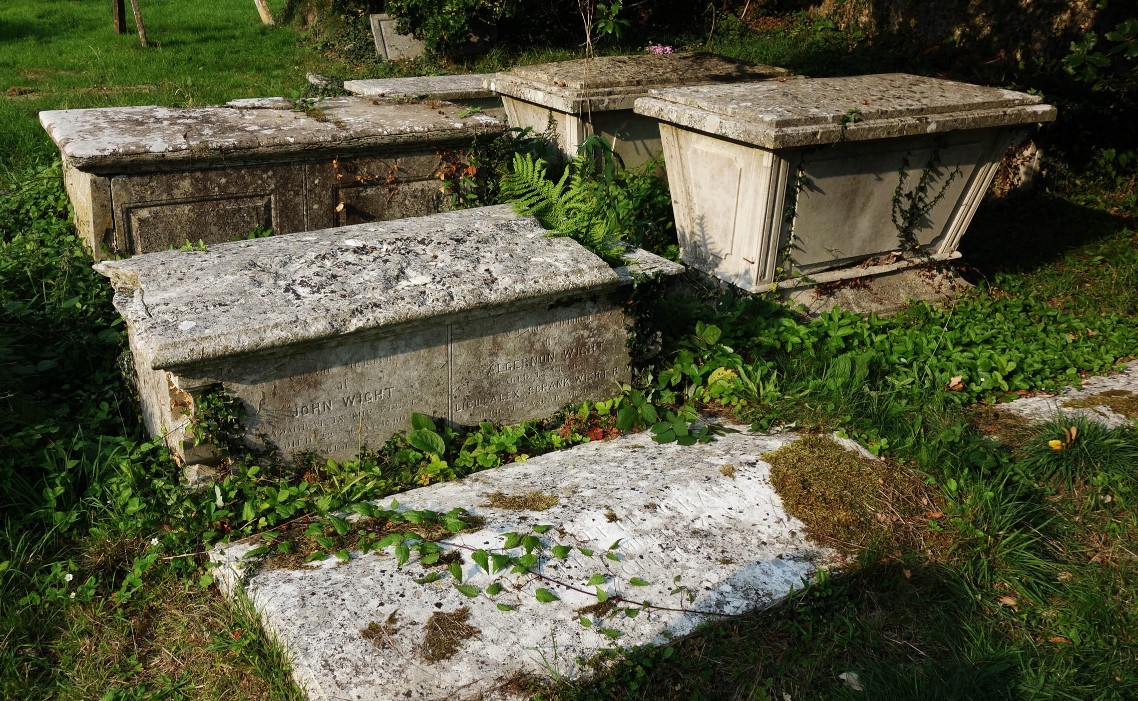
Also commemorated on the tomb are Algernon Wight aged 12 years, (John’s son who drowned) and Lieutenant Alexander Schankwight, who died at Haslar, aged 43. This was John Schankwight’s son and Haslar was the foremost military hospital in Gosport, so it would seem that Alexander had died from an illness or wounds received in the service of his country.
John left Ann with less than £300. This is a paltry sum compared to the legacies of other admirals in the area which usually ran into thousands of pounds (millions in today’s money), and tells a story of its own.
It all proved too much for Ann. When the next census was taken in 1861, Ann was a patient at Thomas the Apostle in Exeter. Not only was the Debtor’s Prison in the area we now call St. Thomas, but so also was the Lunatic Asylum, and the only explanation can be that Anne suffered mental health problems after all the stress, perhaps had a nervous breakdown and was sent there to recover. There was accommodation for 70 patients and Ann would have been expected to pay, thus depleting her dwindling funds.
She did recover but was forced to live in reduced circumstances. The 1871 Census saw Ann living above a butcher’s shop at 7 Triangle Place, Wellington Street, Teignmouth, with William and Martha Knill, the butcher and his wife, as their lodger and with a pension from the Government – presumably a proportion of John’s pension. By now she was 71 and undoubtedly reflecting on her unfortunate life with the Wights which had brought her to these lowly circumstances.
Ann died on 10 July 1878, aged 79. This unfortunate woman left us one more mystery. She is buried in Plot M68 in Teignmouth Cemetery near the Lodge House, in a grave with a simple cross as a memorial. She is commemorated as the widow of Admiral John Wight, yet not buried with him, as he is at St. Gregory’s, Dawlish. Also commemorated with Ann are George John Wight and his daughter Florence Maud, no blood relatives of Ann, but stepson and step-granddaughter.

What the story is behind Ann and John being buried separately we can only speculate. Maybe John’s son, John Schankwight, wanted him buried near his grandfather, Admiral Schank. Perhaps Admiral Schank’s Will stipulated it. John Schankwight would have been happy to distance himself from the unhappy events of the past. Even if so, why was Ann not given the respect of being buried with John when she died? The lack of evidence points to a family in turmoil – a dysfunctional family – who sought to cover over the traces of the disgrace of fraud, Debtor’s Prison, insolvency and desertion. The family would have hoped that their secrets were buried with them and would certainly not have anticipated researchers uncovering them nearly 150 years later.
Or after all that she had endured, perhaps Ann deliberately and consciously chose to be buried separately from John after all that had happened? Perhaps she was the only one who had remained in contact with the renegade George and felt it right to commemorate him and his daughter, but perhaps she felt that she did not want to be anywhere near the man who had caused her so many problems.
One cannot help but feel sorry for this innocent younger woman, who it seems, was so badly treated by the Wight family through no fault of her own. The best that we can hope for is that Ann truly rests in peace.
Researcher: Geoff Wood, from various local, national and international documents, newspapers and Teign Heritage Centre
Writer: Jenny Ridd, from Geoff’s documents, naval biographies, general knowledge of the Georgian Navy and research on the Admirals of Bishopsteignton, Teignmouth and Dawlish


