Introduction to the Georgian Admirals of Teignmouth, by Jenny Ridd
No story of Teignmouth’s most revered men can be told without mention of Admiral Sir Edward Pellew. Indeed, he is not buried in Teignmouth Cemetery but the family crypt at Christow, so his biography will not appear here. However, Pellew’s story gives context and understanding to what followed, that is, the popularisation of Teignmouth as a resting place for retired naval officers. He knew these men and probably actively encouraged them to come here. At one time no less than six admirals and officers were living in the town at the same time - Pellew himself, two Spratts, Anderson, Tobin and Wight.
 Admiral Sir Edward Pellew
Two miles away in the village of Bishopsteignton, several more were living and making their mark. Admirals Thornbrough, Quinton, Goodall and Noble, and other sea captains and commanders were responsible for the westward expansion of the village. They built exquisite mansions, villas and cottage orné and designed superb gardens with all the latest plants and trees being collected from around the world by intrepid plant hunters. All of them used their copious amounts of prize money to do so. Their thousands amount to our millions today, and the legacy of their wealth still shapes our landscape. Nine of their original large properties still survive in Bishopsteignton.
 Tombs of Admirals Thornbrough, Quinton and Goodall in St John the Baptist, Bishopsteignton
In Dawlish churchyard are buried Admirals Wight, Henderson and Schank (or Schanck). This is an extraordinary legacy of high-ranking officers for one small coastal area, and their story deserves to be told as part of a whole and told collectively.
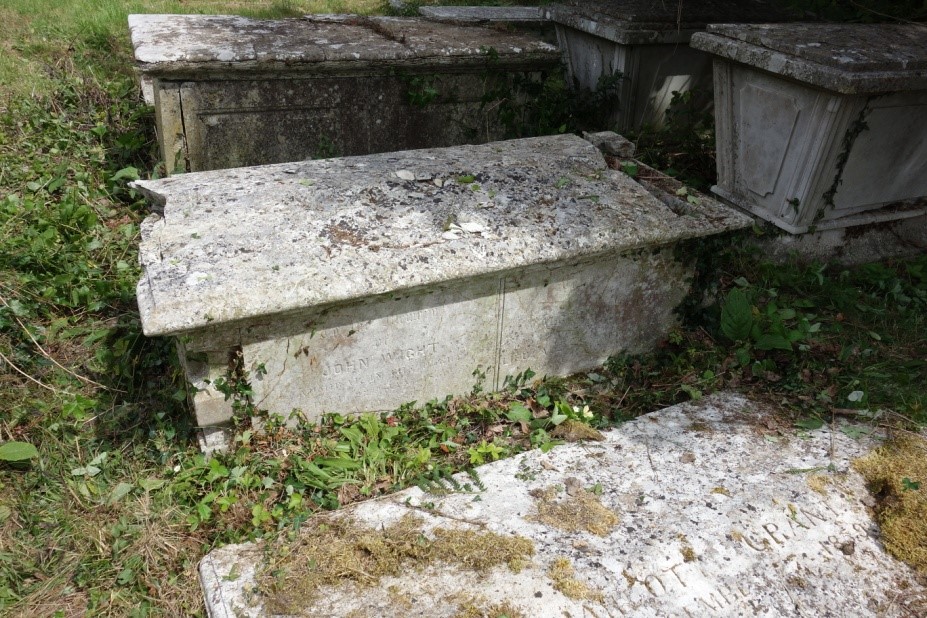 Tombs of Admirals Wight and Shank in Dawlish Churchyard
Pellew was undoubtedly the most famous. After Nelson, it was said, there was no room for another great admiral, but Pellew came close. The Georgian Navy was at its peak, a well-oiled and powerful machine keeping invasion from France at bay. The Navy’s other roles included protecting the trade of a growing empire, keeping her shipping routes open, colonial growth and scientific exploration. It is into this scenario that our admirals came, having played their part in the victory over France and the building of Empire.
It is thought that Pellew was the inspiration for C.S. Forester’s Horatio Hornblower or even Patrick O’Brien’s Jack Aubrey. He will be best remembered for his bombardment of Algiers and his eventual release of 3000 mostly European slaves in 1816. Teignmouth still proudly celebrates Algiers Day today. Pellew became Lord Exmouth and came ashore after this coup. He had already bought West Cliffe House, (now Bitton House, now the Council Offices) in 1812, and retired there aged 60, becoming actively involved with several seafaring charities. He died at home in 1833, having been a hub of dynamism, support and encouragement to others.
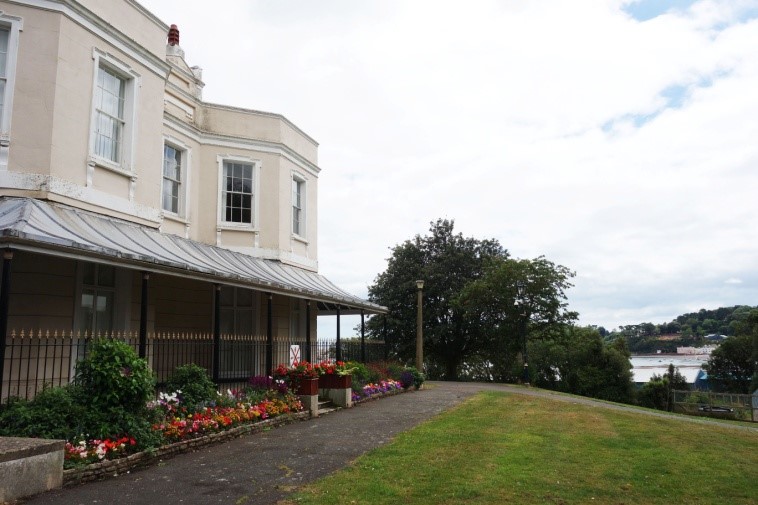 West end of West Cliffe House, now Bitton House, Teignmouth
Torbay was well-known to all Georgian naval personnel for its proximity to Plymouth. It provided sheltered deep-water anchorage for the ships that were moored there to guard the south-western approaches from invasion by France.
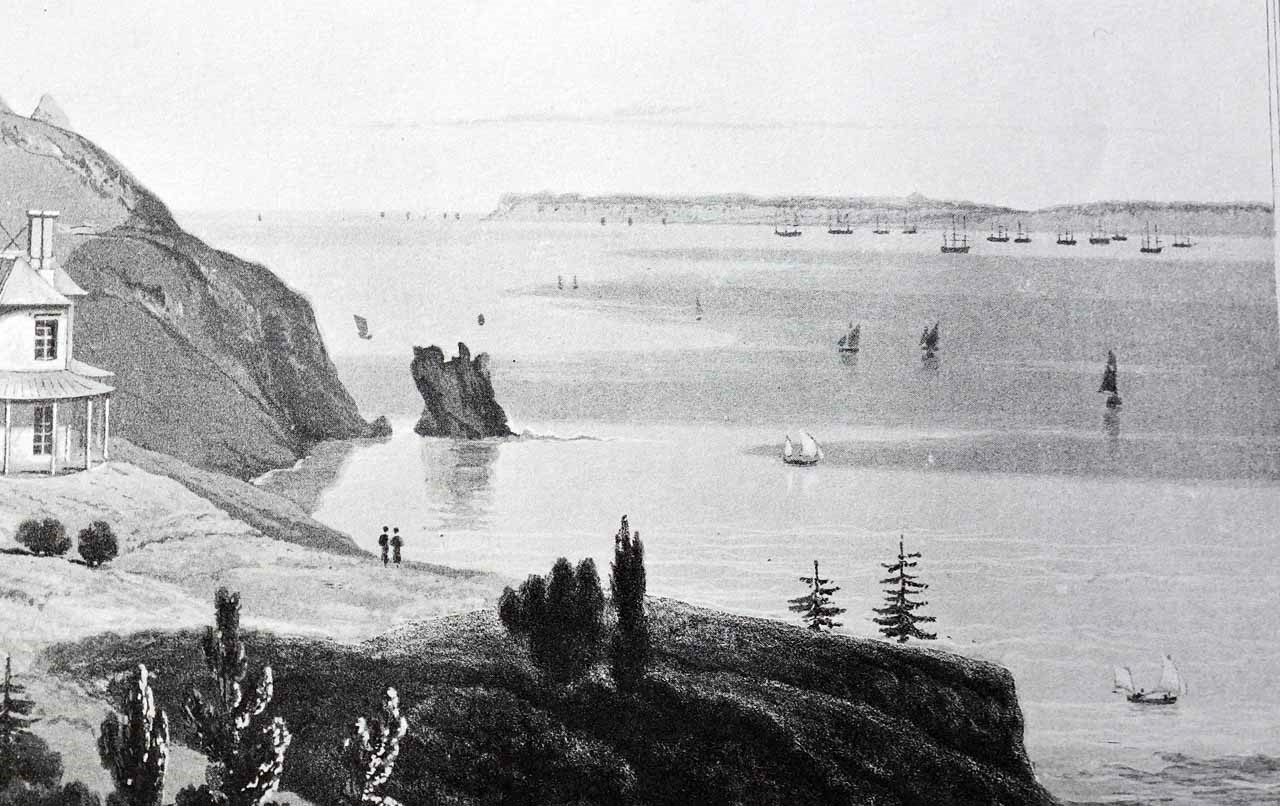 Early 19th century print of Torquay, showing safe anchorage
The naval officers and their families became familiar with the area and came to love the unspoiled countryside, gently rolling hills and spectacular maritime scenery, and so wanted to buy, build or rent houses in the area. It became popular with retired officers, as well as those, still serving and their prize money was the equivalent of millions of pounds today. They were part of the “nouveau riche” with new money, and wanted to emulate the landed gentry with old money. They used it to build every kind of grand manor house, elegant villa or cottage (i.e. large house) imaginable, using John Nash as their inspiration. John Nash worked at Luscombe Castle in Dawlish from 1800 to 1804, and set new trends throughout the area. Bishopsteignton has several Nash-esque houses.
At this time Teignmouth was having to reinvent itself from a small, rather malodorous fishing village into a leading fashionable seaside resort. The wars with France had curtailed foreign travel and the wealthy had rediscovered Britain’s coastal delights, transforming and gentrifying them into the original “staycation” places to holiday. In Teignmouth, there were Assembly Rooms, a Circulating Library built by lithographer and publisher Edward Croydon (see FOTC Facebook site), public baths, bathing machines, good inns and “its accommodation equal, if not superior to any other of a summer resort in Devon”. This was the scene that undoubtedly enticed the naval officers. Wherever they are laid to rest, they were for a while participating in the life of the town and contributing to it.
 Strutt lithograph of early Teignmouth
Their individual lives are largely forgotten although literary works, films and drama have kept the excitement of the period alive. They demonstrate how big events impacted on the lives of ordinary men, sometimes with life-threatening or life-changing consequences and as such, bear retelling to remember those who fought for our country’s freedom and to honour them again.
The Spratts’ story of father and son already appears on this site, with father James fighting alongside Nelson at the Battle of Trafalgar in 1805. He is buried in St, Michael’s churchyard, West Teignmouth, while his son Thomas is in Teignmouth Cemetery. Also in the Cemetery is Admiral Rombulow-Pearse, but he is a Victorian admiral, and so his story is told elsewhere on the site, as he is not part of this Georgian group. He died in 1888, probably having only spent two years in Teignmouth.
Admirals Wight and Tobin are buried elsewhere, but lived in Teignmouth, played an active role in the town, and have relatives in the Cemetery, so some details of their lives will be included in this series.
 Admiral James Anderson
Admiral James Anderson, who is buried in Plot L41 East, will be the first to have his story told.


